— Mara Sapon-Shevin, Widening the Circle: The Power of Inclusive Classrooms (2007)
These questions anchor my philosophy as both an educator and a leader. They remind me that education is not only about knowledge acquisition, but also about shaping a more empathetic, innovative, and just world.
Relationships are the root of all leadership and the foundation of every meaningful educational experience. Through active listening and authentic connection, we can nurture learning communities where everyone feels safe, seen, and valued.
Core Beliefs in Education and Leadership
1. Social and Emotional Learning
We are educating human beings and helping them thrive requires trust, empathy, and psychological safety. By attending to the whole person, we elevate resiliency, celebrate diversity, and cultivate environments where people feel safe, seen, heard, and respected.
2. Collaboration
Great learning is co-created. By recognizing and building upon the experiences and knowledge learners bring, we design democratic spaces that empower voice and choice. I strive to co-curate learning goals, seek ongoing feedback, and promote shared vision across teams.
3. Learning Through Meaningful Experiences
Learning should be relevant, applied, and engaging. I aim to design real-world, inquiry-based learning experiences that spark curiosity and foster lifelong learning.
Example: See how I integrate Inquiry-Based Learning within my learning spaces in my portfolio.
4. Creativity and Innovation
Education must evolve with the world. I believe in embracing experimentation, reflection, and iteration and in encouraging wonder, risk-taking, and design thinking as pathways to growth.
Example: Explore how I use Design Thinking as a tool for creative problem-solving.
The Arts as a Tool for Learning and Expression
I believe the Arts play a vital role in developing creative, critical, and compassionate learners. Art fosters connection, self-expression, and cross-disciplinary understanding, giving learners multiple ways to represent their ideas and engage deeply with content.
The Arts…
- Foster interconnectedness and dialogue between peers, communities, and families (Greene, 2003; Wolf, 1998).
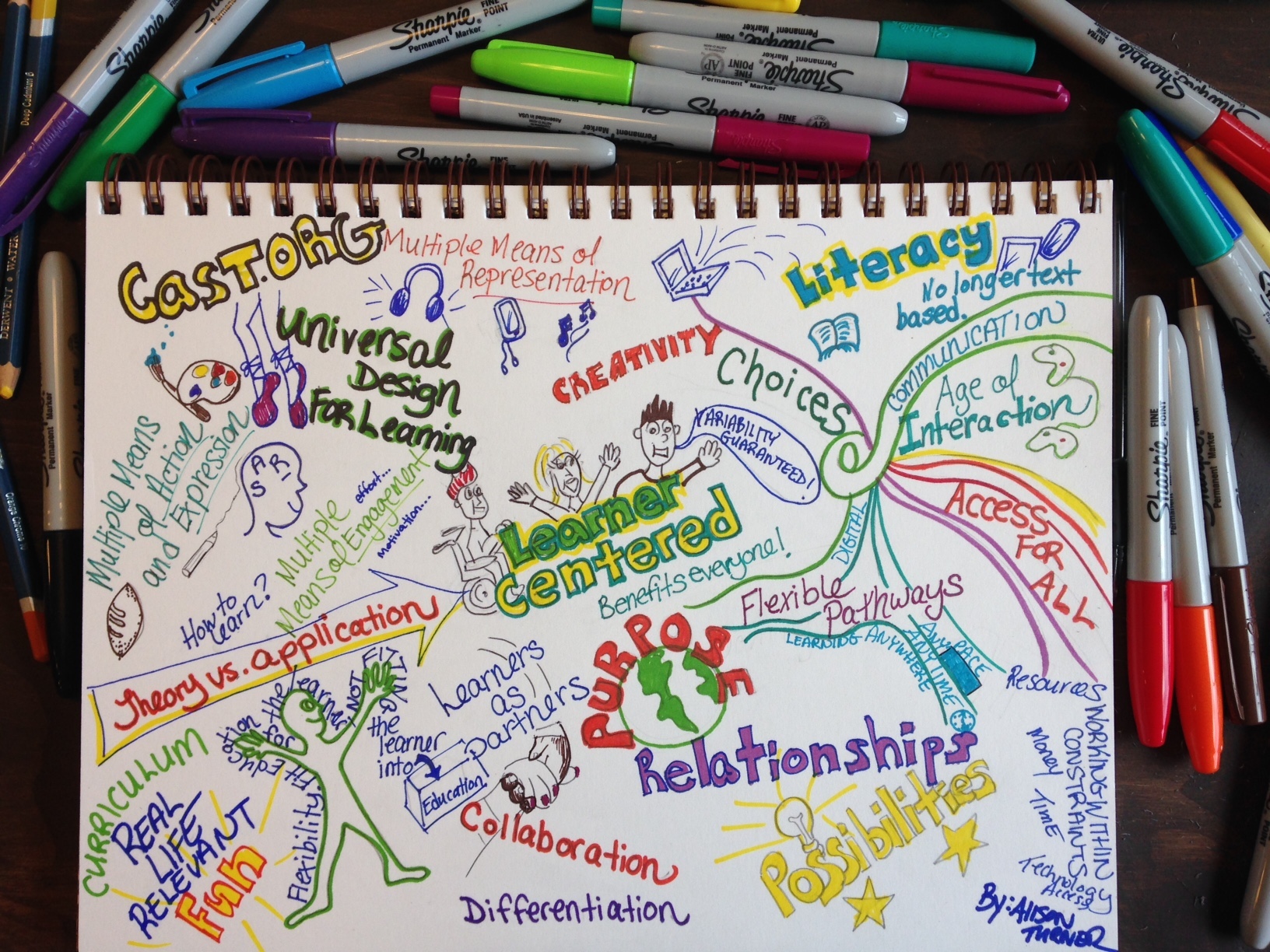
- Support UDL and differentiated instruction by allowing multiple means of representation and engagement (CAST, 2014).
- Encourage imagination, exploration, and learner choice — key ingredients for creativity and voice (Wolf, 2008).
- Cultivate democratic learning spaces where all students are active participants in personal expression and meaning making.
In Summary
At the heart of my teaching and leadership philosophy is a belief that education should ignite empathy, inspire creativity, and empower action. Through inclusive design, collaboration, and reflection, we can shape schools and systems that not only prepare learners for the world but also help create a better one.


References:
Alberta Regional Consortia. (n.d). Visual Thinking Tools. Learning Technologies: Information for Teachers. Retrieved from http://www.learningtechnologiesab.com/learn-more4.html
Center for Applied Special Technologies (CAST). (2013). What is Universal Design for Learning? About UDL. Wakefield, MA. Retrieved from http://www.cast.org/udl/index.html
Fiske, E. B. (1999). Champions of change: The impact of the arts on learning. Retrieved from http://artsedge.kennedycenter.org/champions/pdfs/ChampsReport.pdf
Glass, Don & Meyer, Anne & Rose, David H. (2013). Universal Design for Learning and the Arts. Harvard Educational Review, 83(1), 98-120.
Greene, Maxine. (1995). Chapter 2: Imagination, Breakthroughs, and the Unexpected. Releasing the Imagination: Essays on Education, the Arts, and Social Change (pp. 17-31). San Francisco, CA: Jossey-Bass.
Jensen, Eric. (2003). Chapter 3: Visual Arts. Arts with the brain in mind (pp. 49-70). Alexandria, VA: Association for Supervision and Curriculum Development.
Mason, C. Y., Steedly, K. M., & Thormann, M. S. (2008). Impact of arts integration on voice, choice, and access. Teacher Education and Special Education: The Journal of the Teacher Education Division of the Council for Exceptional Children, 31(1), 36-46.
Minner, D. D., Levy, A. J., & Century, J. (2010). Inquiry‐based science instruction—what is it and does it matter? Results from a research synthesis years 1984 to 2002. Journal of research in science teaching, 47(4), 474-496.
Sapon-Shevin, M. (2007). Widening the circle: The power of inclusive classrooms. Beacon Press.
Tomlinson, Carol Ann & McTighe, Jay. (2006). Integrating Differentiated Instruction & Understanding by Design. Alexandria, Virginia: ASCD.
Wolf, Dennie Palmer. (2008). Building and Evaluating “Freedom Machines”: When Is Arts Education a Setting for Equitable Learning? The Contours of Inclusion: Frameworks and Tools for Evaluating Arts in Education (pp. 4-15). Washington, DC: VSA Arts. Retrieved from http://www.kennedycenter.org/education/vsa/resources/VSA_evaluation_pub.pdf
 alisonlearns